
Jet Ochoa
Jet Ochoa
These cinematic instruments push sound design to the next level, blending vintage character, hyper-realism, and modular flexibility to create textures, atmospheres, and tones that define modern film and media production
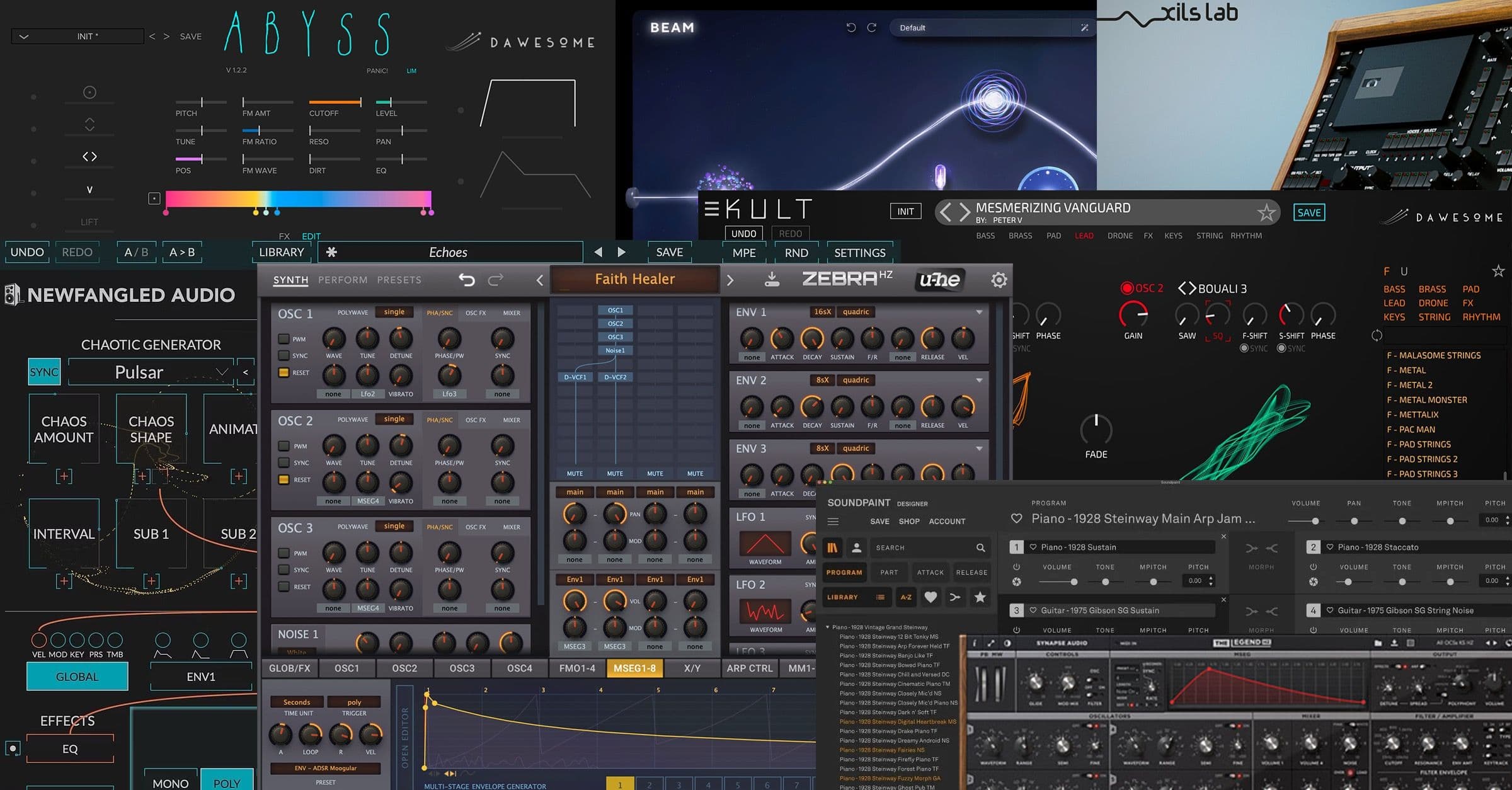
Selections by Thomas Ross & Jet Ochoa
Sound design thrives at the intersection of technology and imagination. Spanning Hans Zimmer’s bespoke synth collaborations to the hyper-realistic worlds of Soundpaint and Lunacy Audio, these instruments redefine what the cinema sound can be.
Hans Zimmer’s name on anything speaks for itself. The Legend, at its core, is a tricked-out Minimoog. The Legend HZ, is a 6-oscillator variant made for and by the film maestro. Zimmer’s classic bass sound and LFO tools are all found, at an essential level, in this one instrument. The modulation matrix is extremely comprehensive, taking edits of initial sounds to new dimensions.
For many, The Dark Knight & The Dark Knight Rises are considered the defining scores of Hans Zimmer’s career. The Dark Zebra offers a variant of Zebra utilized during the making of Christopher Nolan’s Batman thrillers. In its nearly four-hundred presets, designed by Zimmer and Howard Scarr, there’s even sounds that didn't make the cut.
Soundpaint’s Kontakt-like offering is a world of hyper-realism and vintage warmth. As an emulation-first engine, to its strength—there’s a lack of any desire to recreate the UI of the original. Physical layouts logically align in tactile worlds, yet here on a digital machine, it’s much simpler to understand a series of clearly labeled panels and sliders. With each instrument, Soundpaint delivers a clear and honest revision to instruments of the past.
A simple interface brightened by a purple hue is home to a rather complex set of sounds and effects. It deconstructs itself like a lightsaber, with a beam of sound open to modulation. The routing path is formed with nodes, and can be straightforward or diversified to the user’s liking. Ultimately, Beam is a balance between euphoria and digital chaos.
The central component of Cube is an open box, a place for various animations to call home as you customize its large variety of presets. It fills a particular void, bringing natural sounding arpeggios and omnisphere-level customization to a modern program. Ether, macro, and filter are the entry points to edit–building a world in sound through color and sweeps. Eight different soundsources can be interchanged, and orbits allow for a fundamentally unique LFO experience.
TIP: There’s a button to randomize all the soundsources, orbit and effects. It’s bar none for preset creation.
Vintage is the nature of this machine. Don’t get it twisted, it’s no emulation. This is a custom-spec synthesizer of a bygone era with a large variety of presets. VA-3’s beauty is in its limitation, it orients you—naturally, to a particular sound.
The otherwise unobtainable French sound of the ‘80s is revived in modern format via Xils Lab’s PolyKBIII. Morphing oscillators were a first in this instrument’s original. Its software counterpart pushes innovation further sporting a seven-option changing panel. You’ll find unique routing paths, presets, and more within the unit. Simple, beautiful animations call VOICE XY and SPACE XY home. The PolyKBIII is a stunning, carefully crafted love letter to an important world.
Cinematic sounds and composition come to life with Generate. The instrument brings additive synthesis to a non-standard format. Across its primary panels, there’s “Chaotic Generator,” “Wavefolder,” and “Low Pass Gate.” These panels include a clear set of controls that can be easily routed in modular format. Generate heavily encourages and features MPE support, bringing expression to new heights. As a finishing touch, there’s an EQ for embellishment, accompanied by a small suite of effects: Chorus, Delay, and Reverb. If an MPE controller is in sight, and you love twisting basses–check out Generate.
In Abyss, each patch captures attention with a defining tone color gradient. This central piece best explains the instrument’s emphasis on harmonics and texture. LFO’s to the left are central, affecting drones and sonics with modulation. Connect the LFO and polyphonic pitch bend to relive the THX theatrical experience.
TIP: At a low enough value, the LFO transforms to a step sequencer.
It wouldn’t be surprising if a Star Wars targeting program was the visual inspiration for Kult. Monotone linear fonts and jagged lines spanning reds and yellows form the interface. Kult’s sound matches its level of intensity and precision. It isn’t complex by nature…in Dawesome’s own words, “Modulation system: deep when you need it, simple when you don’t.” This is a two oscillator system with a filter and some modulation. Subtractive synthesis at its best…alive.